A way for Black and Latino communities to unite
Chicago has always been a city of neighbors. Close enough to hear each other’s music through the walls, and to share sidewalks, porches and corner stores.
Yet, for decades, Black and Latino communities have been positioned not as allies, but as competitors for funding, employment opportunities or survival itself. That fracture didn’t just happen by accident. It was carefully engineered through redlining, disinvestment, criminalization, tax increases, language barriers and policies that taught us to mistrust one another instead of the systems that harmed us both.
The cost of that division lives in the exhaustion of Chicago Public School parents, the guardedness of longtime residents and new neighbors concerned about crime, the way people retreat from civic life because simply making it through the day takes everything they have.
Jan. 20 is the 10th anniversary of the National Day of Racial Healing, and it is critical to note there is a weariness moving through this city that can’t be measured by crime statistics or budget spreadsheets.
Commentary
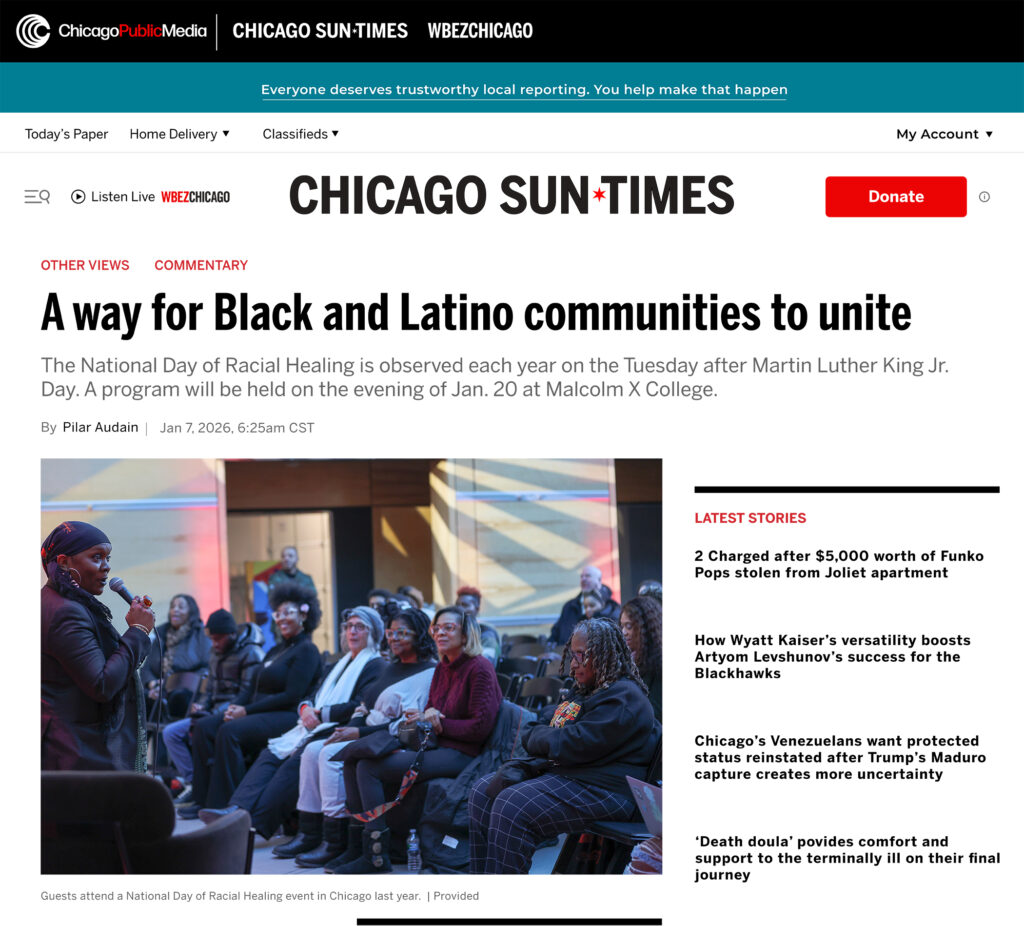
The event at Malcolm X College, in partnership with Healing Illinois and the City Colleges of Chicago, is an invitation to remember the light that lives inside every person. Through storytelling, community members and Chicago-area residents will share brief reflections of love, resilience and perseverance.
I witness that Black and Brown Chicagoans are tired of fighting — not just physically, but deep in our souls. Many are tired of the unabridged list of double standards that stretches back to the Great Migration, tired of reacting instead of healing and tired of institutions that address symptoms without tending to the actual source of the wound.
I know this fracture intimately, and I also know what it looks and feels like when it begins to heal from the inside out.
In 1998, as a University of Illinois Springfield college student living in Auburn-Gresham, I was embraced by fellow student Carolina “Caro” Gaete and her family in Little Village, near 26th Street.
At that time, tensions between Black and Latino communities were dangerous. Gang violence, cultural misunderstandings and language barriers made solidarity between the fragile communities feel unattainable.
Caro would ride back to the city with me, and we would make stops by one another’s homes to greet our mamas. Our budding friendship was nurtured by our mothers, both of whom have passed on. Mama Jackie, my Black Creole mother from Louisiana, and Mama Sonia, Caro’s Chilean mother, modeled something radical in its simplicity: Stay in the relationship. Be patient and forgiving. Listen longer than you speak. Celebrate culture and the things that draw you together.
Caro and I didn’t agree on everything then, and we don’t now. For almost 30 years, we’ve stretched each other. We learned how to hold tension without breaking trust, a lesson that has shaped my life’s work as well as hers.
Today, I am executive director of Truth, Racial Healing & Transformation Greater Chicago, and Caro leads powerful organizing work through Blocks Together in the West Humboldt Park community. Our professional paths differ, but the root is the same.
Truth, Racial Healing & Transformation Greater Chicago is part of a national initiative launched by the W.K. Kellogg Foundation and shaped by the visionary work of Dr. Gail Christopher, author and former senior adviser and vice president of the foundation. The organization has been quietly building the muscle for this work in Chicago with trainings and convenings.
Being a lifelong Chicago resident has taught me a few things. One truth is that racial inequity is not only structural — it is relational and spiritual. This city has a history deeply rooted in political and economic relationships, creating a culture where loyalty, personal ties and one’s address are almost as impactful as official policy.
But it is not possible to “policy” out of mistrust if people are living in survival mode. Healing is not a detour from justice but the very ground that justice stands on. Healing is needed to achieve equity.
Where do we begin?
The National Day of Racial Healing is a start. It is a day residents can come to listen and feel emotion, remembering the light each person carries. Healing is how to move from survival to participation.
Chicago does not need more division. There must be spaces dedicated to the truth of shared humanity. On Jan. 20, there will be light to share. And from that light, a future of power can grow. The future rests in the ability to see one another.
Thank you to the Suntimes for this poignant and timely Op-Ed.
Thank you to everyone who has held this work with care and courage. We owe gratitude to the ancestors, to community voices unmuted, and to the everyday acts of bridge-building that happen quietly, faithfully, in our streets and homes.
Chicago is beautiful in its cultural preservation, home to the DOPEST artists and educators, yet complicated by deep inequities. Black families in our city face poverty rates nearly three times the overall average, and Latino families also carry disproportionate burdens in access to jobs, services, and opportunity.
The net worth gap between Black/Latino and White households here remains a stark reminder of structural exclusion…and yet, in that terrain of inequality WE STILL STAND… we keep striving.
We are stronger together. Join us for the National Day of Racial Healing and let’s listen to one another’s powerful stories. Click the link tree in our Bio to register. One Love. ❤️
A way for Black and Latino communities to unite
Executive Director of Truth, Racial Healing & Transformation Greater Chicago
Sun Times Contributor